

Click here to view image
Author/ School/ Dating:
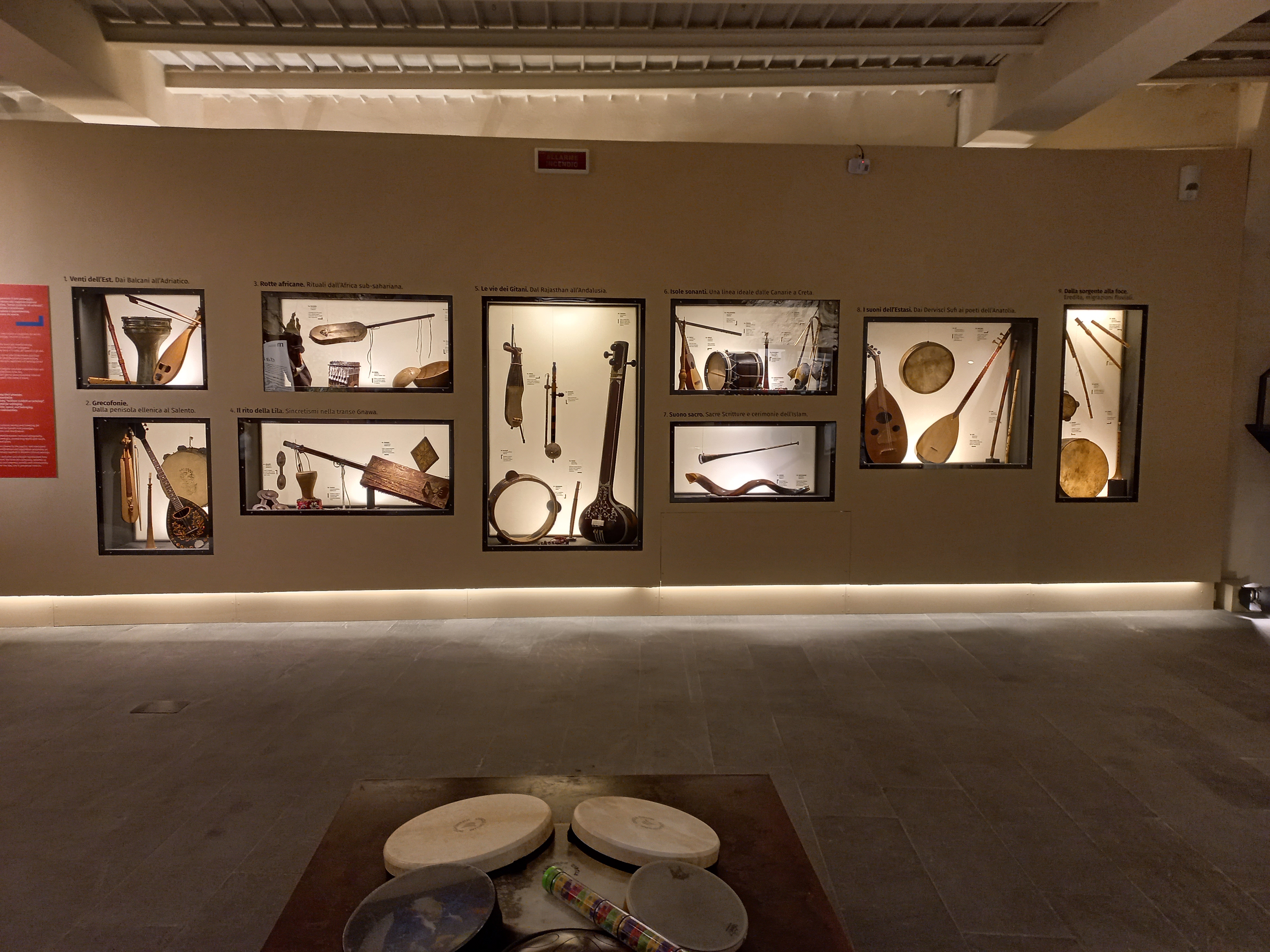
The display of the instruments
Back to Focus:
 Museums in Genoa

Click here to view image
The display of the instruments
Click here to view image
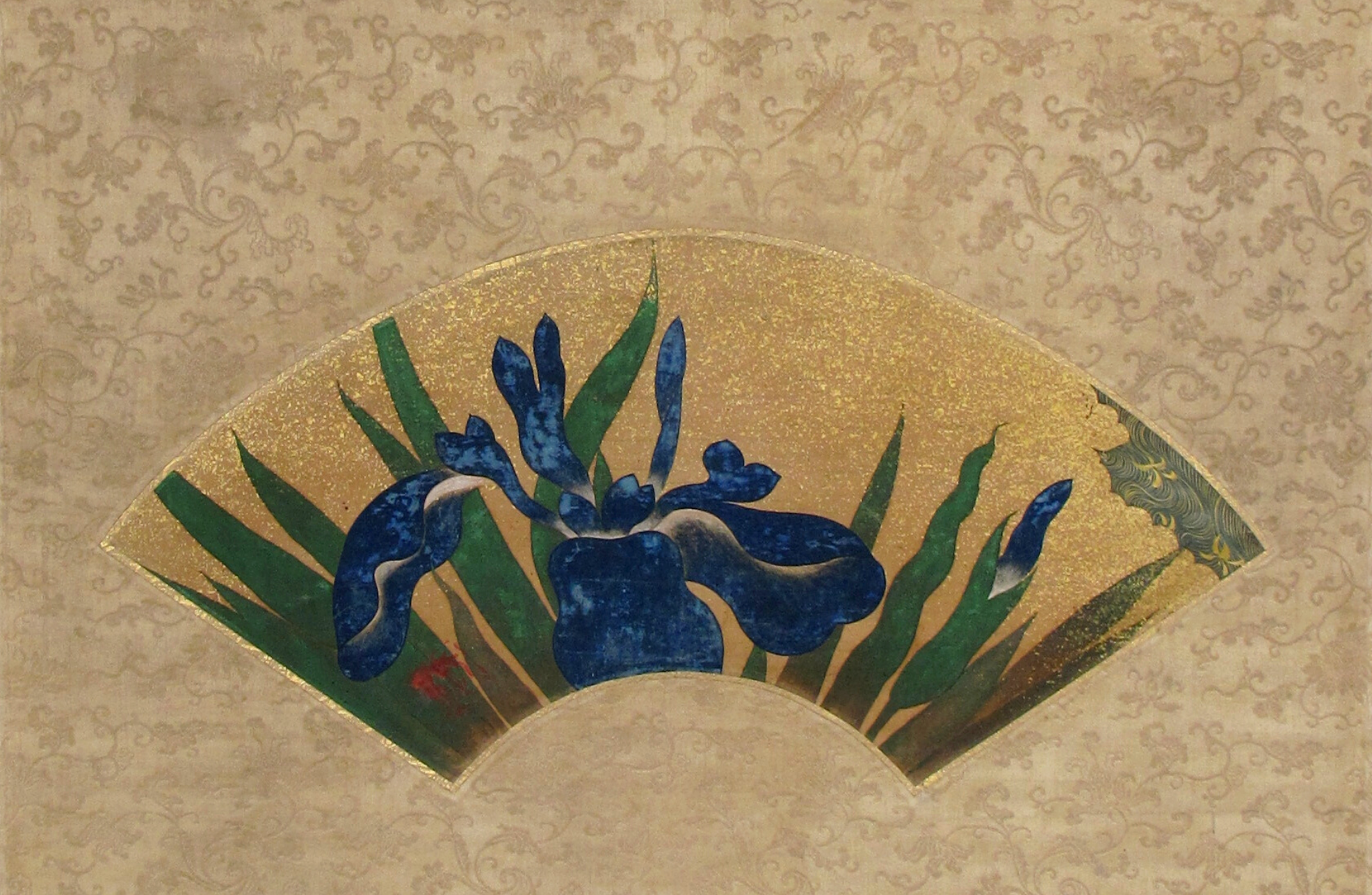
Otaga Korin, Rinpa School, Japan, Edo period (1603-1868)
Fan
Fan in kekejiku format, ink, colours and gold on paper
The iris kakitsubata (杜若) stands out for its beautiful purple flowers with shades tending to blue. The falling sepals recall the ears of a rabbit and are mottled with white. Its leaves, resembling swords, can reach up to 70 cm. The kakitsubata blooms in the springtime.
This is a fan painted on paper, mounted like a kakemono (a roll to hang), datable 1711-1736. The blue irises are placed on a golden background, to show their preciousness: the background is an ocher cloud, sprinkled with crumbs of gold leaf; we perceive the limit of the cloud only at the right end, where we see a bluish-green pond. In it we can see some slight streaks that refer to golden spirals, on which the iris grows. These petals and leaves are outlined with a fine brush dipped on black ink. Moreover, Kōrin opts for a close-up of a fully open kakitsubata, whose falling sepals suggest an already advanced flowering, in contrast to the flower still in bud on the right.
Click here to view image
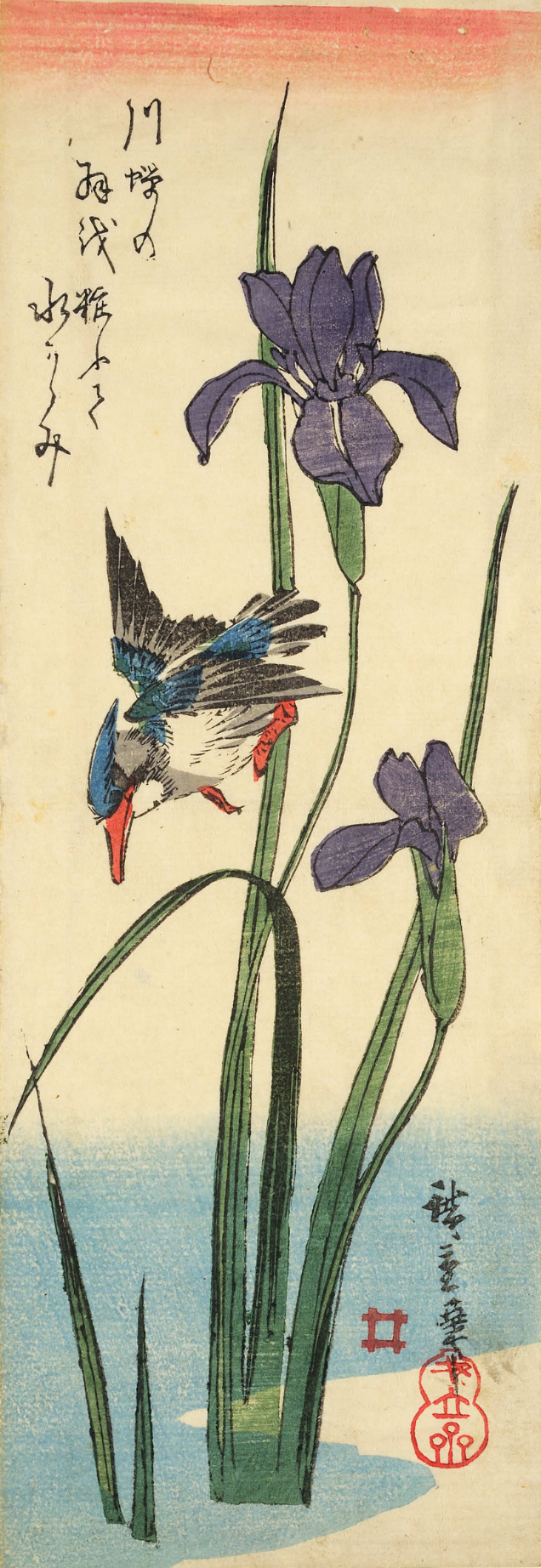
Kingfisher flies through the irises
Utagawa, Hiroshige
ukiyo-e woodblock print
1842 - 1844 - XIX
S-0351
Unità di misura: cm; Altezza: 33.5; Larghezza: 11.4
carta giapponese- xilografia
Fiori d'Oriente Arte e Poesia, metafore simboli nella cultura artistica e letteraria del Giappone - Genova, Museo d'Arte Orientale E. Chiossone - 21 aprile 2011 - 30 ottobre 2011
Click here to view image
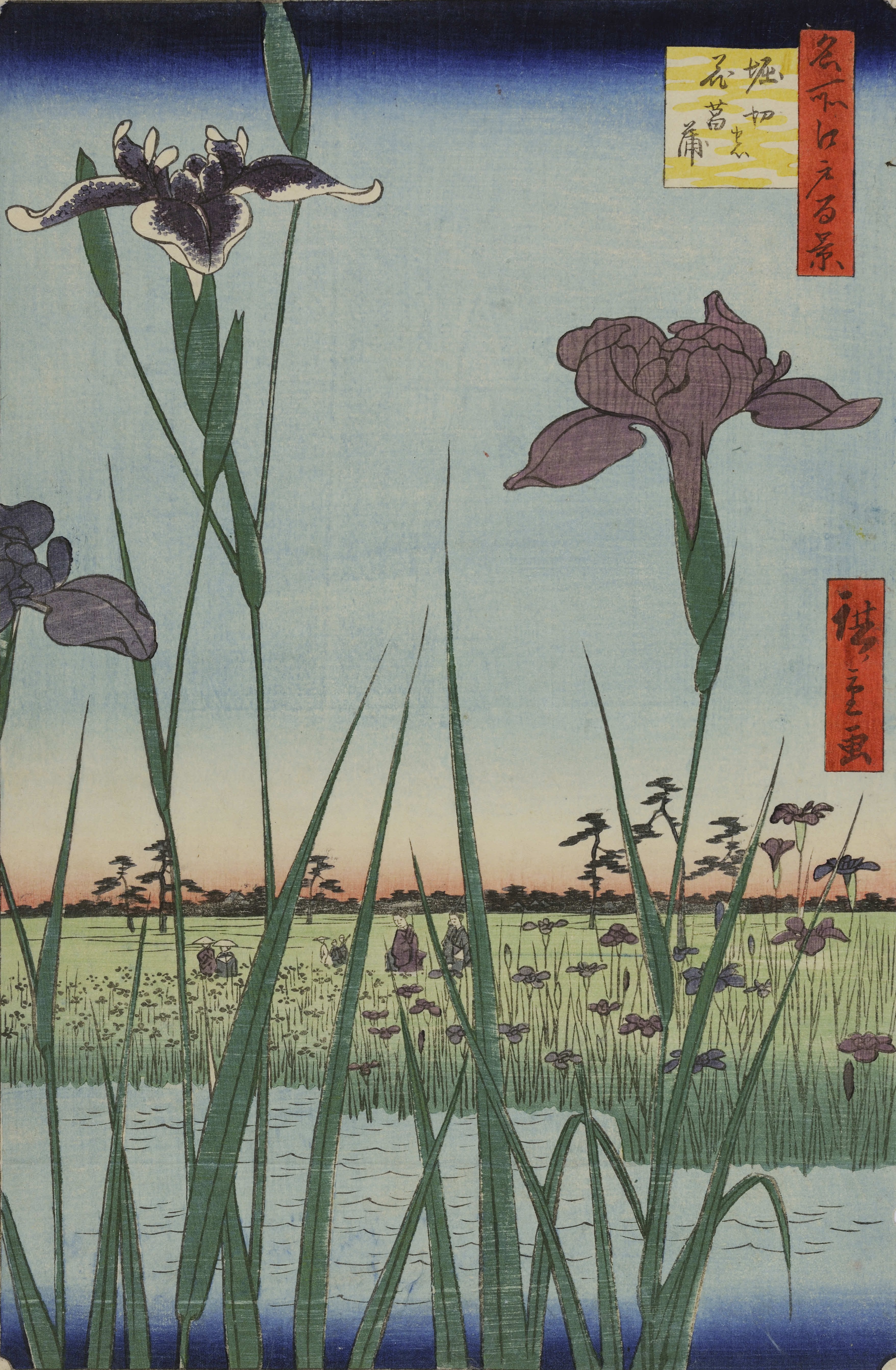
Utagawa Hiroshige, Japan, Edo period (1603-1868)
Polychrome woodprint
Nishikie polychrome woodprint, ink and colours on paper. Vertical Ōban, 36.2 x 24.8 cm
The iris hanashobu (花菖蒲) grows in a humid soil close to streams and ponds, it has a wide variety of colours and is characterized by a yellow streak. During the Edo period, this type of iris became very popular and it was cultivated in more and more gardens; in the capital Edo (present-day Tōkyō) it became fashionable to visit these gardens and iris fields as a form of entertainment during the summer evenings, to enjoy the coolness of these green areas far from the city centre. Among these gardens, the Shōbuen of Horikiri (堀 切 菖 蒲 園), still visited and much loved by Japanese people, became the most popular. Here the irises were cultivated specifically to be sold at the Edo market.
In this print, datable 1857, part of the series "One Hundred Views of Famous Places in Edo" (Meisho Edo hyakkei 名 所 江 戸 百 景) Hiroshige portrays this very garden, and, with a clever game of overlaps, manages to concentrate in a single work two types of prints, landscape and kachōga (flowers and birds). In the foreground are indeed portrayed with extreme accuracy three varieties of hanashōbu, while in the distance we glimpse girls who came from the city to the garden to enjoy the beauty of flowers and the evening breeze, as suggested by the red horizon indicating the sunset.
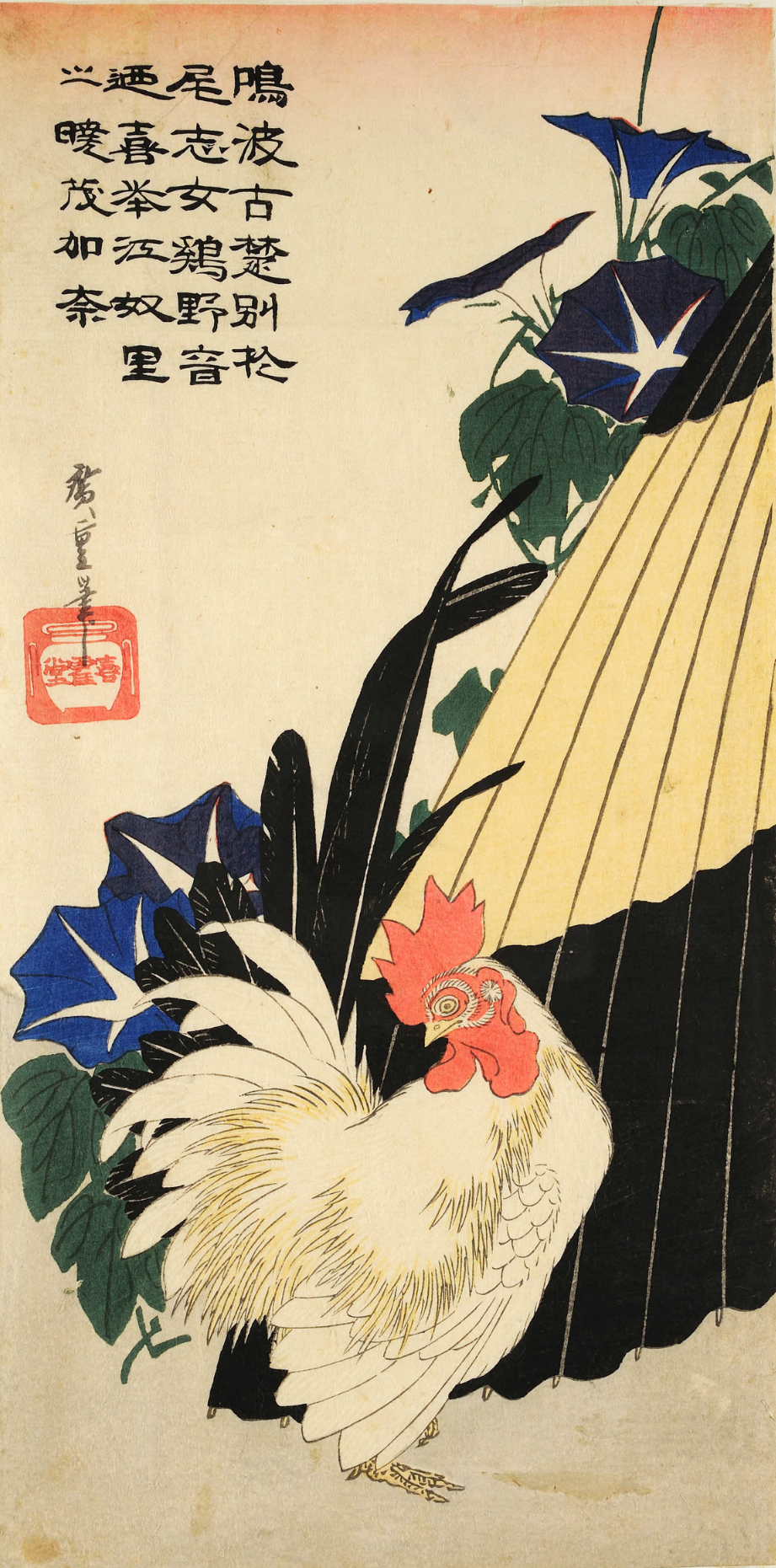
Click here to view image
Utagawa Hiroshige, Japan, Edo period (1603-1868)
Polychrome woodprint
Nishikie polychrome woodprint with karazuri impression. 35,4 x 17,9 cm
This print, datable 1830-1831, is set in the early morning of a summer day, which can be understood analysing the different elements. The rooster is the protagonist, symbol of the morning awakening, royal and motionless, in a delicate pose; the bright red of the crest and the dirty white of the feathers are really highlighted.
The Morning glory behind him, in Japanese “asagao” (朝顔)“the face of the morning” contrasts the background with its intense blue and symbolizes the end of the night, because it has a particular characteristic: it withers during the night and blooms again during the morning in the summertime. Being a climbing and weeding plant, the bindweed blooms wherever it finds a wall to lean on: this is why it was very appreciated and used in Japan for decorative purposes.
The third element is the yellow and black umbrella, of which only a side can be seen. Known as “janomegasa” (蛇の目傘)” bull’s eye umbrella”, because of his decoration of coloured circles, it is used to shelter from the rain during the rainy season tsuyu (梅雨), that happens in Japan from early June to the middle of July: this is the same period of the bindweed’s flowering.
The rooster is not well seen in classical poetry and in ladies’ diaries in the Heian period: indeed, its morning call interrupted the lovers' passionate night meetings.
Finding the umbrella open and resting on the ground, we can imagine that nearby there are the two lovers, at which the poem reported in the print alludes, who struggle to separate after the night spent together. As the verses written in Chinese style in the upper left say, the two lovers sigh "how beautiful would be the dawn of a country where the rooster would not be heard!".
We therefore understand that the rooster - usually depicted with a swollen chest while making its call - in this print remains silent, refraining from giving lovers the regret of having to divide.
Here is the complete composition, which perfectly represents the function of the rooster.
鳴けばこそ / 別れを押し目 / 鶏の音の / 聞こえぬ里の / 暁悲しも
nakeba koso / wakare mo oshime / tori no ne no / kikoenu sato no / akatsuki kanashi mo
Reluctantly we part at the rooster’s singing: how beautiful would be the dawn of a country where the rooster would not be heard!
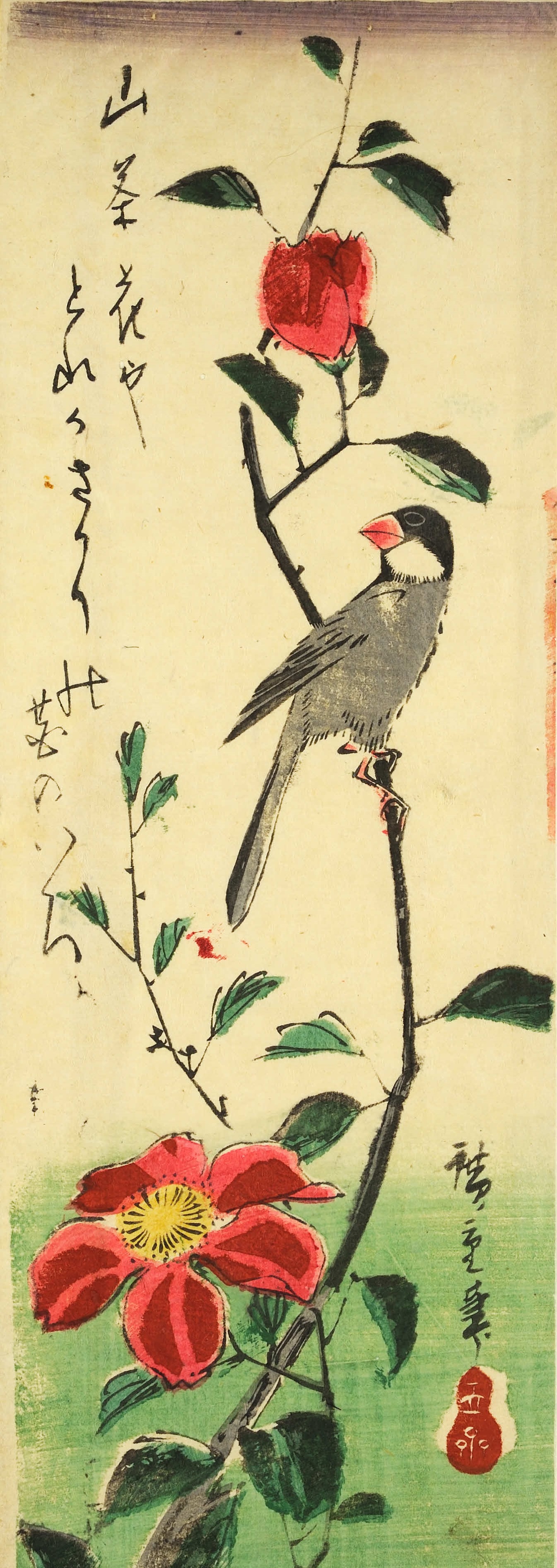
Click here to view image
Utagawa Hiroshige, Japan, Edo period (1603-1868)
Polychrome woodprint
Nishikie polychrome woodprint, ink and colours on paper. Chūtanzaku format, 33.2 x 11.5 cm
This print, datable around XIX century, is extremely simple: only two subjects are represented on an empty background, decorated only by a bright green in the lower part of the print. This choice creates a balance between the image and the piece of poetry on the left part.
The two subjects are a finch with ashy plumage and the camellia branch it is using as a perch for its rest. Contrary to other representations of the Camellia Japonica (known as “Tsubaki” 椿 or ツバキ in Japan), there is no snow here, but a flower in the height of its flowering can still be noticed in the lower part, while there is a bud on the verge of hatching immediately over the finch. This suggests that the scene is set during springtime, even though this flower is normally associated with winter because its flowering happens in December and January.
The choices of representing the branch in the vertical position and of painting the flower in red give a particular elegance to the whole composition.
The camellia is an evergreen plant, in Japan considered sacred since ancient times, and praised for the splendor of its flowers and the robust texture of its leaves. For practical purposes, it has always been used to produce oils and tea. According to floriography, the language of flowers (花言葉 “hana-kotoba” in Japanese), the meaning of the camellia varies based on the colour of its petals. The red camellia assumes the meaning of “the virtue of modesty”, the white one the meaning of “impeccable beauty”, while the pink one the meaning of “modest beauty”. However, there’s another interpretation: the camellia would represent “the woman who committed a crime”. This second reading is linked to Alexandre Dumas’s “La Dame aux Camélias”, a story about love and betrayal, and the Italian opera “La Traviata” by Giuseppe Verdi. Furthermore, the camellia plant has always been considered, since ancient times, a symbol of longevity in Japan: as a matter of fact, 32000 years for a man would correspond to only one year for the plant.
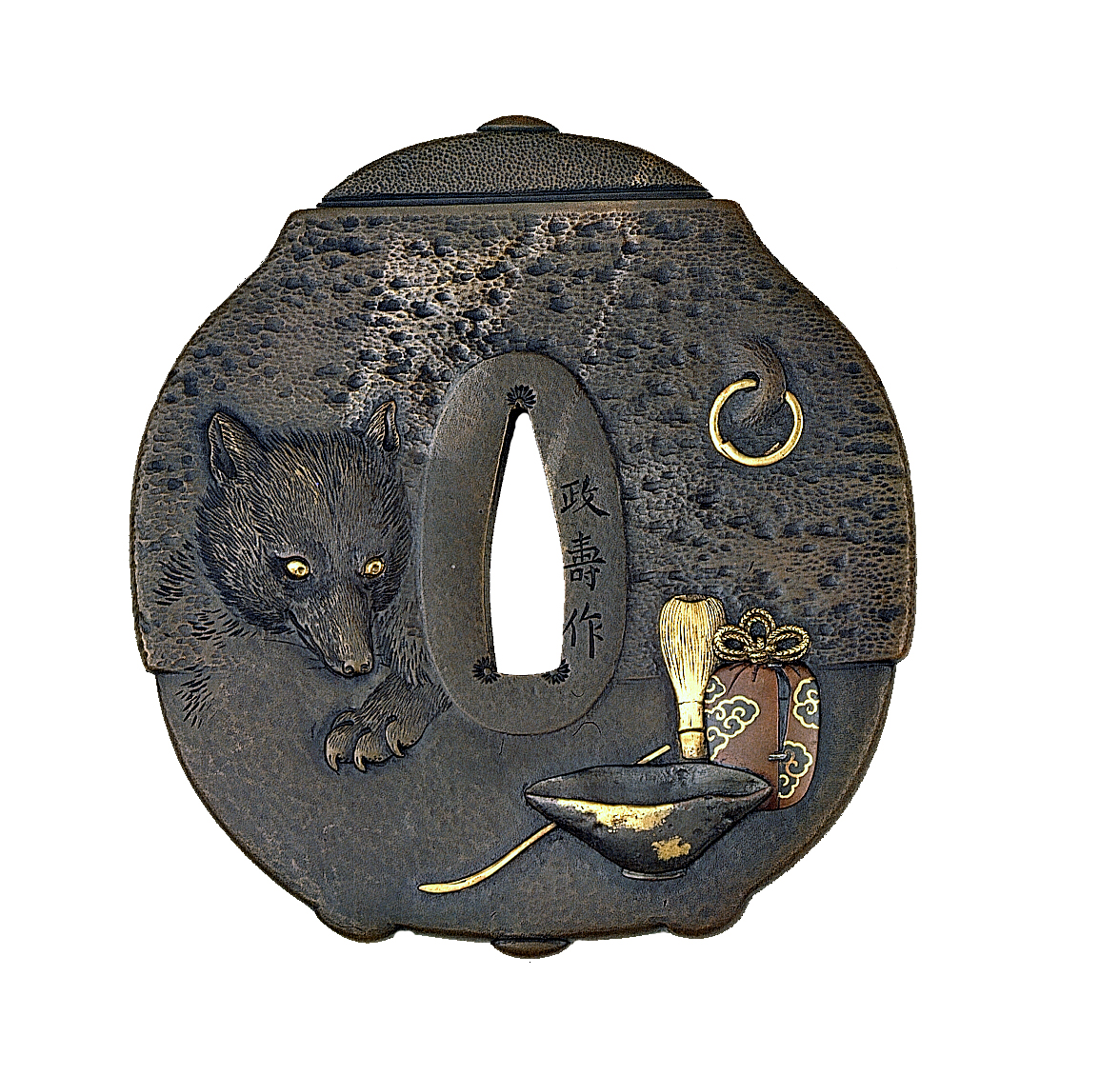
Click here to view image
Hamano school, Japan, Meiji period (1868 – 1912)
sword accessories
bronze inlaid with gold, silver, shakudō and copper, 9,2 x 8,6 cm
The artist, who signed himself Masatoshi, reproduces in this tsuba (sword hilt) a chagama, a kettle for making tea, with a wealth of details: the lid, the feet, the side rings to suspend it on the fire. Inlaid in gold, silver and copper, we find the whisk, the box for the matcha tea powder, the cup and the measuring spoon. Only looking at the face of the tanuki (Japanese raccoon) and the ura side (back) where the animal's tail appears, we realize that the kettle is the body of the tanuki itself. In fact, the tale of Bunbuku Chagama tells that the abbot of the temple of Morinji, a great lover of chanoyu, was preparing to use a new kettle he had just bought when it let out a cry of pain and jumped away from the fire. Incredulous, the abbot saw four legs, a thick tail and a tanuki head sticking out of the chagama. Once caught, the kettle returned to its normal shape but the abbot, to get rid of the problem, gave it to a peddler who passed through the temple. Once home, the tanuki revealed himself to the peddler and begged him not to put it on the fire; in exchange it offered to help him earn money by performing for the crowds. Every day a large paying public gathered to observe the shape-shifting tanuki, thus making the fortune of the peddler.
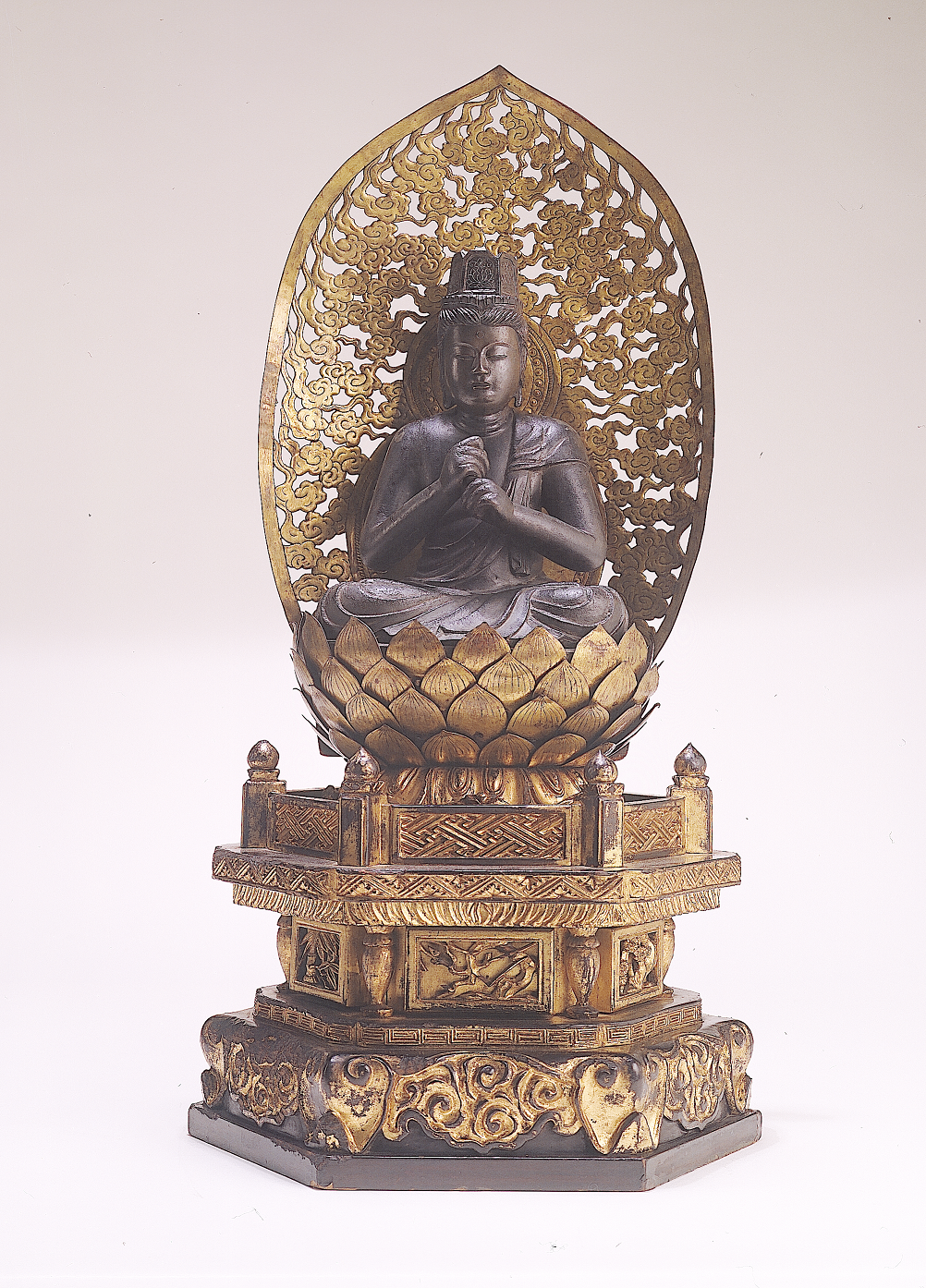
Click here to view image
Japan, mid Edo period (1673-1751
statue
cast and lacquered bronze; base in wood carved, lacquered and gilded, h. 55,7 cm x ø base 29
Dainichi Nyorai “Great Sun Buddha” (skt. Mahavairocana), is known also as the primordial Buddha or the cosmic Buddha from which the entire universe emanates. In Japan Dainichi Nyorai has been adored since the Heain period (794-1192) as the central figure of the Esoteric Buddhism (Mikkyō). The deity is depicted as a young prince adorned with jewels, a polygonal crown and thin mustaches. The hands are in a characteristic hand gesture called the “Mudra of Six Elements” (jpn. chiken-in) in which the index finger of the left hand is clasped by the five fingers of the right. This mudra symbolizes the unity of the five worldly elements with the spiritual consciousness.
Click here to view image
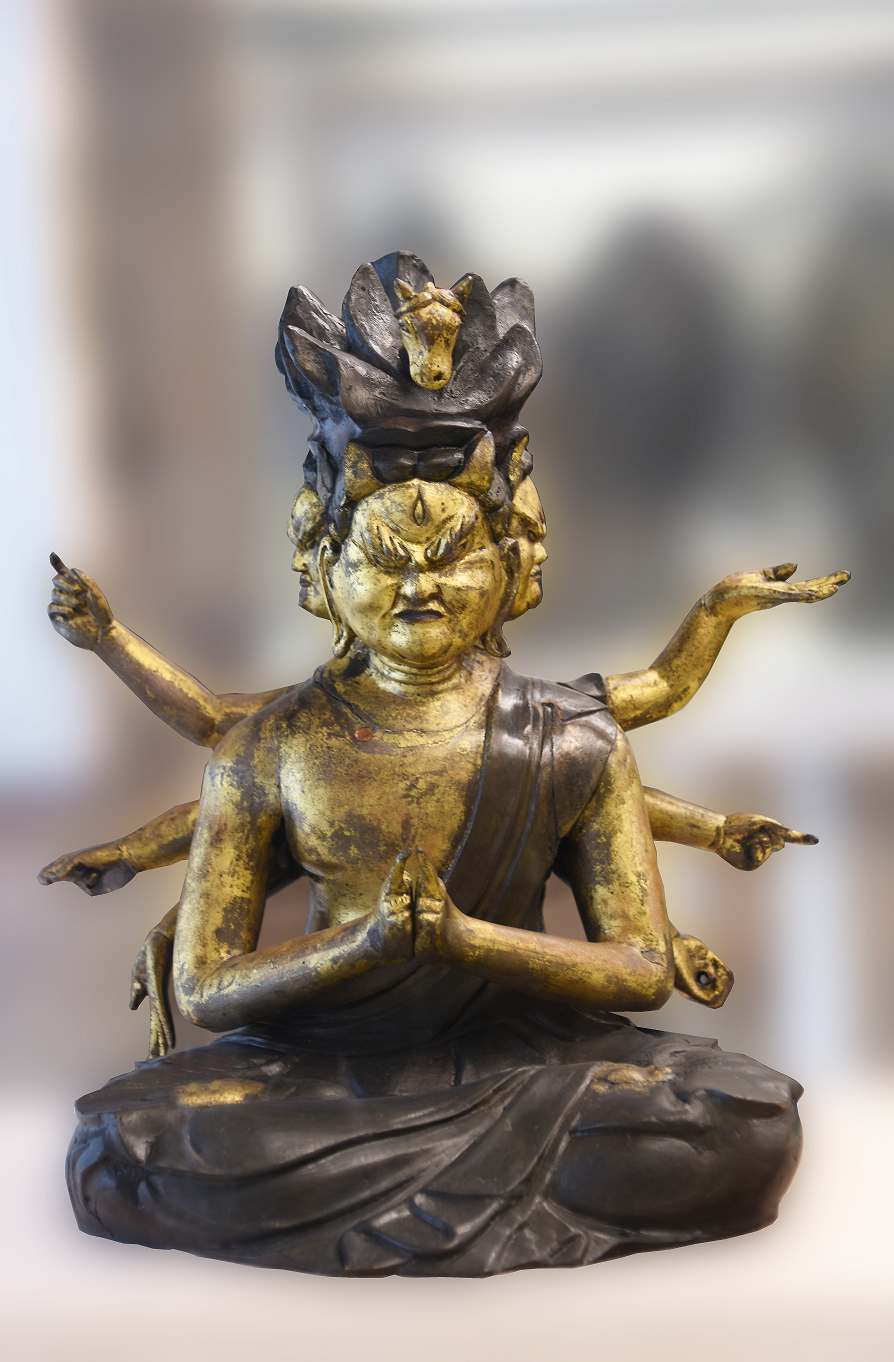
Batō Kannon
Collezione Edoardo Chiossone 1898 Genova - lascito testamentario
ambito giapponese
Japan, mid-late Edo period (1673-1800
statue
- XVII-XVIII
B-1218
Unità di misura: cm; Altezza: 28; Larghezza: 26; Profondità: 18
bronzo- fusione, patinatura, pittura
Click here to view image
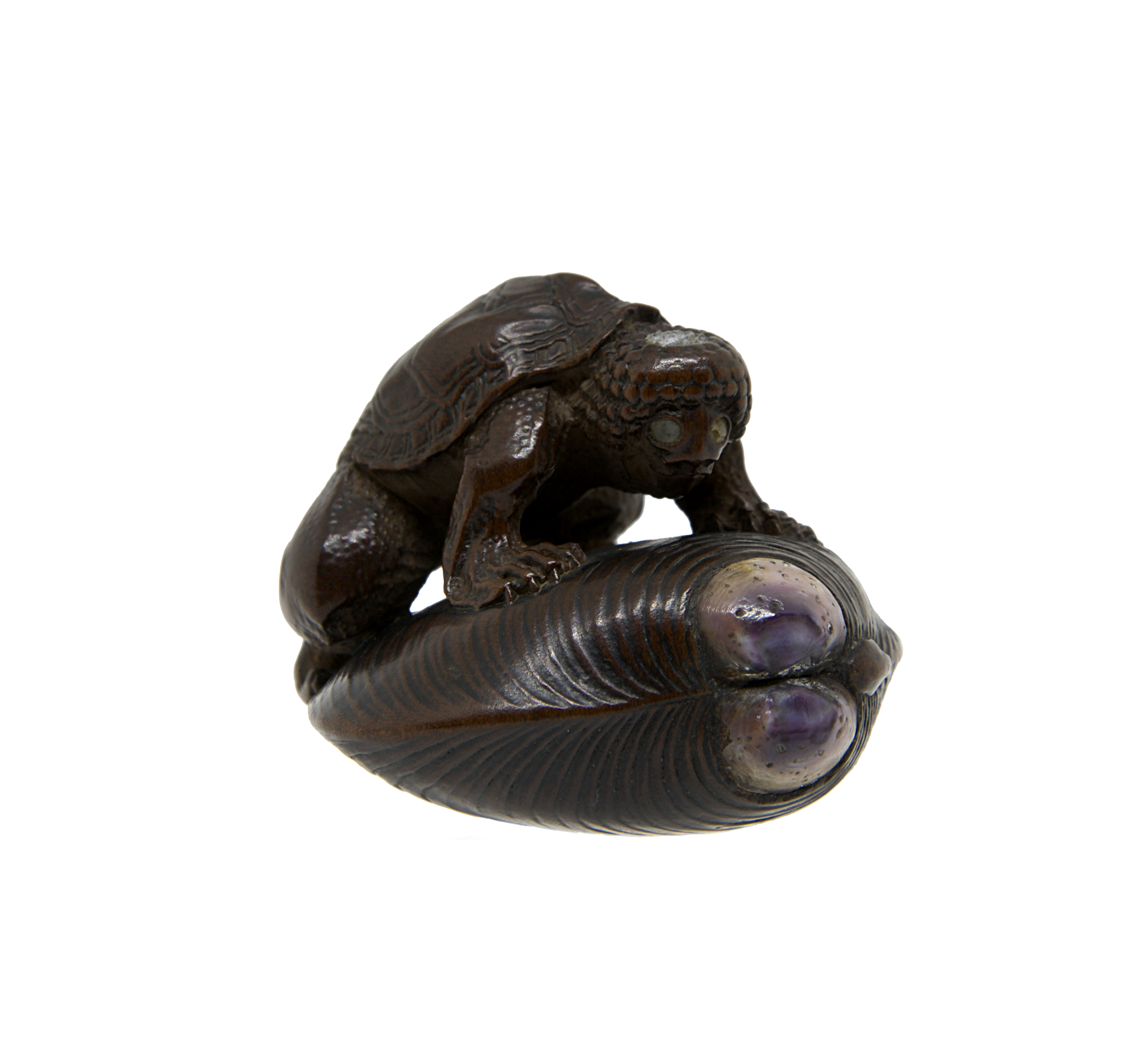
Komin, Japan, second half of 19th century
Netsuke, men's clothing accessory
Patinated and engraved wood, eyes, inlaid with shell, ivory, pewter, 3 x 4 cm
Kappas are creatures from Japanese mythology that inhabit lakes, rivers, and ponds. They are described as child-sized humanoid beings with turtle-like shells and scaly skin ranging from green to yellow. They have webbed hands and feet that help them live in an aquatic environment. The kappa's main feature is a cavity on its head filled with water; however, this is also its main weakness: if the water were to spill it would risk death.
In our netsuke a kappa is firmly resting on a hamaguri shell: a hind leg of the creature is stuck inside between the two valve, from which the mollusc can be seen spilling out, made in ivory. The junction of the hamaguri is made of shell, while the cavity on the head is made of pewter. The signature of the author, Komin, is inserted within a gilded rectangle at the base of the shell, along with the seal (kakihan). Several other pieces with the same subject and signed by Komin are well known.