


Il paggio, giochi col levriero

Click here to view image

Titolo dell'opera:

Page. Greyhound games

Autore:

Boldini, Giovanni

Object Type:

painting

Epoca:

1866 - 1866 - XIX

Inventario:

GPB 610

Misure:

Unità di misura: UNR; Misure mancanti: MNR

Tecnica:

olio su tela

Descrizione:

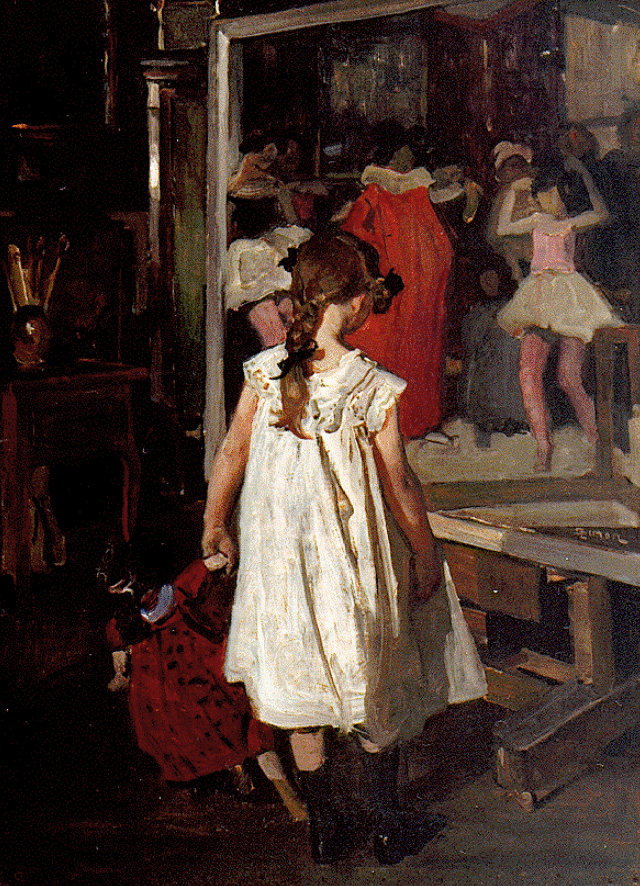
This small costume scene is an interesting example of Boldini's early pictorial production, traceable to the late 1860s. The furnishings give the setting an evocative tone, well aligned with the revival taste of the second half of the 19th century. The warmth and familial intimacy of the scene support the thesis that it was Alaide Banti, the daughter of the Macchiaioli painter Cristiano, with whom the young artist had stayed during his Florentine period, who dressed the costume. The deep bond that united Boldini to Alaide is testified not only by the dense correspondence but also by the numerous paintings and drawings depicting her: despite a marriage proposal rejected in 1903 due to Cristiano Banti's opposition, the relationship between the two would never be interrupted. The painting would enter the Luigi Frugone Collections in 1928 - again thanks to Stefani - while Alaide would disappear the following year: on that occasion Boldini called her his “fiancée of already 60 years.” The painting shows a young girl in Renaissance pageboy clothes as she is intent on playing with a greyhound, lying on a large sofa. On the background is a tapestry while the floor is covered with a rug.

La pittrice (1874)

Click here to view image

Titolo dell'opera:

The painter

Acquisizione:

Luigi Frugone 1928 Milano - legato

Autore:

Bianchi, Mosè

Object Type:

painting

Epoca:

1874 - 1874 - XIX

Inventario:

GAM 1523

Misure:

Unità di misura: cm; Altezza: 75; Larghezza: 62

Tecnica:

olio su tela

Descrizione:

The work comes from the Genoese collection of Giuseppe Bertollo's heirs, auctioned at the Galleria Scopinich in Milan in May 1928. In 1936, it was included in the volume on Luigi Frugone's collection compiled by Enrico Somarè. The painting depicts a pleasant female subject in neo-eighteenth-century terms, in a style and with influences perhaps inspired by the artist's stay in Paris in 1866, during which he had the opportunity to become acquainted with the work of two virtuosos of the brush, Mariano Fortuny and Jean-Louis Meissonier. There is a version of this painting, probably from the same period but more sketchy in tone, belonging to a private collection, in which the features of Carolina Marignani, the artist's wife, have been recognised. A watercolour, formerly in a private collection in Milan, is dated 1872 and is considered to be an early idea for this canvas. The museum has two other paintings on wood by Mosè Bianchi, belonging to the estate of Lazzaro G.B. Frugone: “Barca a Chioggia” (Boat in Chioggia) and “Vecchia Milano” (Old Milan), both dating from the mid-1880s. In this canvas, signed and dated “Mosè Bianchi/Milan 1874”, the intensity of the light illuminating the scene serves to highlight the almost miniature-like preciousness of the details, rendered in enamelled colours with an approach reminiscent of the style of painter Giuseppe Bertini, Bianchi's teacher. At the centre of the scene, the figure of the painter stands out in her dark clothes, focused on the painting in front of her.

Miss Bell

Click here to view image

Titolo dell'opera:

Miss Bell

Acquisizione:

Luigi Frugone 1953 Genova - legato

Autore:

Boldini, Giovanni

Object Type:

painting

Epoca:

1903 - 1903 - XX

Inventario:

GAM 1524

Misure:

Unità di misura: cm; Altezza: 205; Larghezza: 101

Tecnica:

olio su tela

Ultimi prestiti:

XVIII Biennale di Venezia - Venezia - 1932

Descrizione:

The work was bought by Luigi Frugone in 1926 from the dealer Ferruccio Stefani. In a letter, the collector does not hide his enthusiasm for the possession of the painting, for which he uses the adjective ‘unsurpassable’. The painting was actually destined for the Marquise Matilde Giustiniani Pallavicini Durazzo of Genoa, who wanted to start a collection of modern works of art. But Stefani did not give up proposing it to Luigi, due to the friendly and privileged relationship he had established with the industrialist, and sold it to him for 130,000 lire. In 1932, at the 18th Venice Biennale, on the occasion of the retrospective dedicated to Giovanni Boldini, "Miss Bell" was exhibited with the explicit indication of Luigi Frugone's ownership. Portrait of an elegant young woman, possibly identifiable as an actress from the Comédie Française, Marie Jeanne Bellon, known as Miss Bell. The canvas is signed and dated “Boldini 1903”. The portrait, with its lively and casual air, is characterised by a framing that captures the subject from top to bottom: the composition is rebalanced by the spiral movement of the clothes, which, together with the quick and synthetic brushstrokes, gives airiness and momentum to the whole. The contrast between the black colour of the bow and hair, the luminous whiteness of the neckline and the iridescent red of the dress contributes to giving the painting a very strong emotional impact, so much so that it has become the symbolic image of the Frugone Collections.

La contessa Beatrice di Bylandt (1901)

Click here to view image

Titolo dell'opera:

Countess Beatrice de Bylandt

Acquisizione:

Luigi Frugone 1926 Genova - legato

Autore:

Boldini, Giovanni

Object Type:

painting

Epoca:

1901 - 1901 - XX

Inventario:

GAM 1525

Misure:

Unità di misura: cm; Altezza: 52.5; Larghezza: 55.5

Tecnica:

olio su tela

Descrizione:

The portrait of Countess Beatrice de Byland, painted in 1901, was the first painting by Boldini to enter Luigi Frugone's collection. The “beautiful head by Boldini” mentioned by Ferruccio Stefani in a letter, accompanied by a photograph, sent to Frugone from Venice on 30 June 1926, was owned by Alphonse Ory of Paris and, thanks to Stefani and the mediation of Mrs Campeggi (a woman active in the art market), it was purchased by Luigi Frugone for around 40,000 lire. From the correspondence between the Milanese gallery owner and Frugone, it is clear that negotiations for the purchase of the painting went on for some time. The portrait of Countess Beatrice de Byland arrived in Venice from Paris on 4 August 1926 and was delivered to Luigi Frugone by Stefani himself, who, shortly afterwards, wrote that he had “finally discovered” that the painting, before belonging to Alphonse Ory, had been left in the painter's studio by the lady portrayed “because she did not consider herself to be reproduced beautifully enough”. Although small in size, the portrait bears the artist's unmistakable signature style, characterised by quick brushstrokes of vibrant colour, perfectly suited to conveying the melancholic and sensual charm and natural elegance of a leading figure in Parisian high society.

Povero ma superbo (1878)

Click here to view image

Titolo dell'opera:

Poor but superb

Acquisizione:

Luigi Frugone 1928 Genova - legato

Autore:

Cremona, Tranquillo

Epoca:

1851 - 1878 - XIX

Inventario:

GAM1528

Misure:

Unità di misura: cm; Altezza: 87.7; Larghezza: 67.2

Tecnica:

olio su tela

Descrizione:

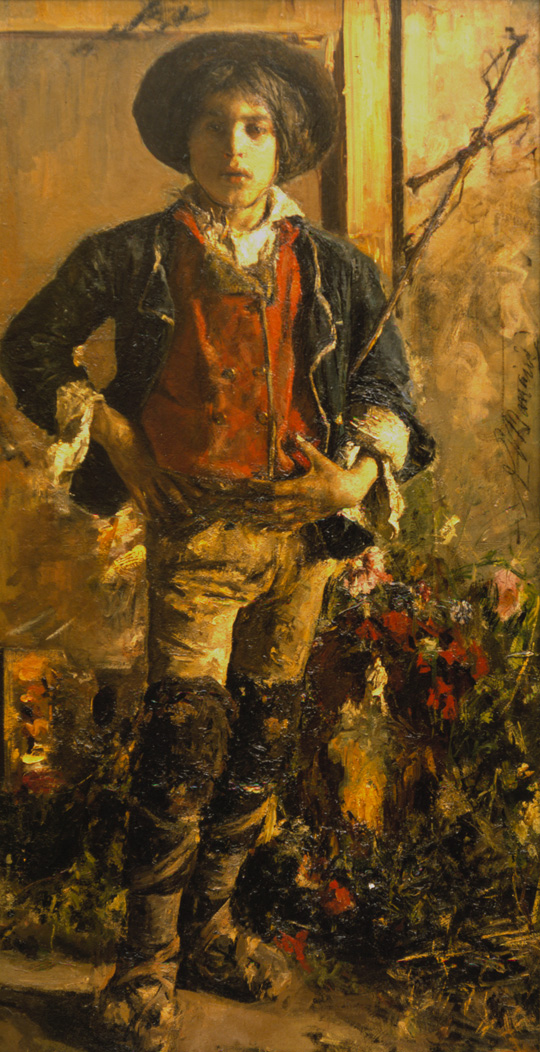
Tranquillo Cremona was, together with Luigi Conconi and the Russian sculptor Paolo Troubetzkoy, both present in the Frugone collections, an exponent par excellence of the Lombard Scapigliatura and of that anti-academic reaction that led Italian bohemian artists to prefer subjects connected to real, everyday life over great historical representations. Portraits, female figures and genre scenes became the favourite themes of the Scapigliati artists, who, in the field of painting, reached the dissolution of form for a free relationship between light and colour. In the case of this canvas, which appeared in a monograph of the artist with the title "Piccolo ciociaro" (Little Ciociaro), the socially inspired dissolution of the subject's forms is evident. Portrait of a boy; the subject is slightly off-centre to the left of the canvas and emerges from the undefined background, forming a single vortex of light and colour.

L’ Amaca

Click here to view image

Titolo dell'opera:

The hammock

Acquisizione:

Luigi Frugone 1953 Genova - legato

Autore:

De Nittis, Giuseppe

Epoca:

1860 - 1884 - XIX

Inventario:

GAM 1533

Misure:

Unità di misura: cm; Altezza: 42.2; Larghezza: 65

Tecnica:

olio su tela

Descrizione:

The work is part of a group of paintings – the other two versions with the same subject and the painting ‘Breakfast in the Garden’ are in the Municipal Art Gallery Museum in Barletta – which the painter dedicated to his family, his wife Léontine Gruville and his son Jacques. Struck down suddenly by a cerebral haemorrhage on 21 August 1884, he left the Genoese version among his last pictorial testimonies. The work is a sort of variation on the more famous ‘Breakfast in the Garden’ exhibited at the Paris Salon in 1884. In ‘The Hammock’, the brush builds the image with broad strokes of colour, lingering on certain details: 'the cat's face in Léontine's lap, the glint of glassware on the tray, the gathering of light in the background behind the woman's face' (Monti in Giuseppe De Nittis 1864-1884, 1990). If the work is compared with its namesake in the Museum of Barletta, where the two figures are framed from a slightly raised viewpoint, in this canvas the artist retains greater compositional ease, like a rhythm stretched over the length of the suspended, swaying seat, while the light filters through the green like a swarm that seems to lift flakes of mother-of-pearl on the dress of the reclining woman. The scene is probably set in the garden of De Nittis' new home, purchased in 1880 and located near Avenue de Villiers, a residential neighbourhood that was fashionable among artists at the time. The artist pauses to contemplate his wife and son, first at the table and then on the hammock in a relaxed conversation. The woman is rocked by the movement of the hammock, holding a white kitten in her lap. De Nittis focuses his attention on the reflections of the sun filtering through the vegetation onto the tablecloth and household objects; the varied position of a chair and the shadows marked by the passing of time also catch the eye. The space containing the figures is vast and bright, dominated by a wide range of greens.

Il cavaliere indiano in vedetta

Click here to view image

Author/ School/ Dating:

Paolo Troubetzkoy (Verbania, 1866-1938)

Technique and Dimensions:

bronzo, cm 53x56x29

La scultura raffigura un pellerossa a cavallo, attrazione del circo americano denominato "Grande Spettacolo del West" diretto da William Frederick Cody (più noto con il nome di Buffalo Bill), di passaggio a Milano durante la tournée del 1891. Si tratta di una replica del bronzo presentato alla Esposizione Annuale della Permanente Milanese nel 1893 e, sempre nello stesso anno, con il titolo semplificato In vedetta, all’Esposizione Nazionale di Belle Arti di Roma, insieme ad una variante dal titolo In corsa.
Le diverse versioni di questo soggetto testimoniano il favore incontrato da queste piccole sculture presso il pubblico: oltre al gesso databile al 1891, conservato presso il Museo del Paesaggio di Verbania-Pallanza, tra le fusioni in bronzo, ricordiamo quella datata 1893 conservata dalla Galleria Nazionale d’Arte Moderna di Roma.

Alessandro Milesi "Sospiri"

Click here to view image

Titolo dell'opera:

Bridge of Sighs

Acquisizione:

Legato Frugone Genova - legato

Autore:

Milesi, Alessandro

Object Type:

painting

Epoca:

Inventario:

GAM 1582

Misure:

Unità di misura: cm; Altezza: 118; Larghezza: 78

Tecnica:

olio su tela

Descrizione:

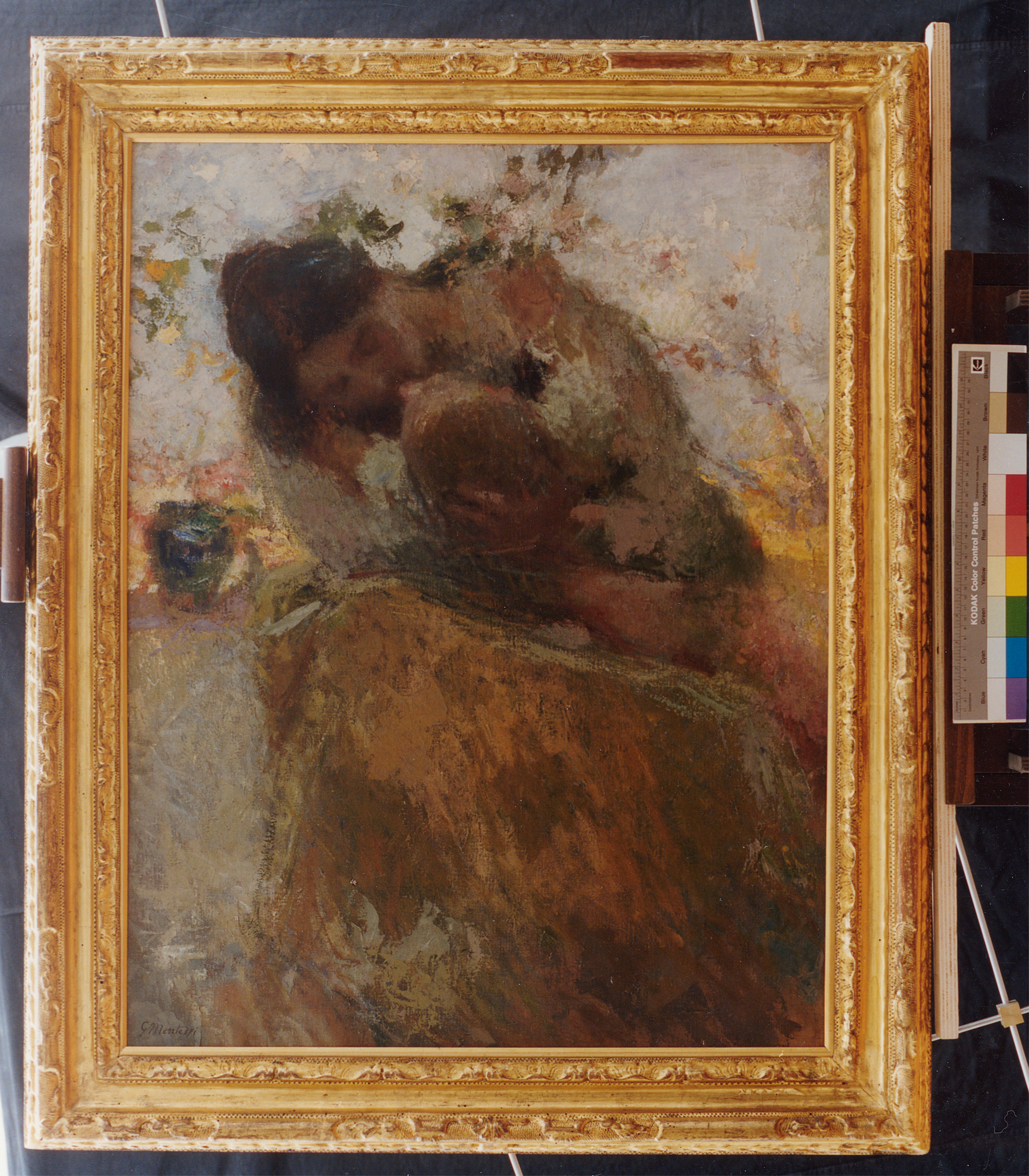
The painting depicts a dramatic and popular story: a woman hugs her children at the exit of the prison where her husband is detained. The three are crossing the Ponte della Paglia in Venice, right next to the criminal prisons. The little girl has her head bowed and appears to be in tears, while the baby has dozed off with his head resting on his mother's shoulder. The wind and the opacity of the air, rendered with indefinite brushstrokes, convey the gravity of the moment, the woman's great despondency and concern.

Bricole

Click here to view image

Author/ School/ Dating:

Pietro Fragiacomo (Trieste, 1856-1922)

Object Type:

dipinto

Technique and Dimensions:

olio su tela, 24 x 40 cm

Firmato in basso a destra “P. Fragiacomo”, [1889]

Nina e Ninetto. Ritratto femminile con cane

Click here to view image

Author/ School/ Dating:

Lino Selvatico (Padova, 1872 - Treviso, 1924)

Subscribe to