Pattuglia di cavalleggeri (1885-1890)

Click here to view image

Titolo dell'opera:

Cavalry patrol

Acquisizione:

Legato Frugone 1928 - legato

Autore:

Fattori, Giovanni

Object Type:

painting

Epoca:

1885 - 1889 - XIX

Inventario:

GAM1536

Misure:

Unità di misura: cm; Altezza: 42.4; Larghezza: 62.5

Tecnica:

olio su tela

Descrizione:

The painting technique used does not correspond to that of the “macchia” style, which proceeds by combining colours, but rather makes use of overlapping and sfumato. The work was exhibited at the first Biennale in 1921 under the name Cavalleggeri e Bovi (Cavalrymen and Oxen), in 1927 as Manovre di artiglieria (Artillery Manoeuvres) and was purchased without the mediation of Ferruccio Stefani. Set in a country road that the painter depicts on other occasions, with its row of houses, wall and cypress tree, it is populated by three figures of soldiers and a child guarding animals, shown from behind, according to a device that gives depth to the work and allows the observer to identify with the scene being contemplated.

Telemaco Signorini "Ligurian vegetation in Riomaggiore"

Click here to view image

Titolo dell'opera:

Ligurian vegetation in Riomaggiore

Acquisizione:

Luigi Frugone 1953 Genova - legato

Autore:

Signorini, Telemaco

Object Type:

painting

Epoca:

1892 - 1899 - XIX

Inventario:

GAM 1577

Misure:

Unità di misura: cm; Altezza: 58; Larghezza: 90

Tecnica:

olio su tela

Descrizione:

Painter, critic and polemicist, Signorini, the son of an excellent Florentine Vedutist painter, was one of the great animators of the Macchiaioli group. The Macchiaioli met in Florence at the Café Michelangelo and from 1855 had undertaken a revolution in painting which aimed to overcome the dominant "academic" culture. His enthusiasm for experimentation led him to travel to Venice and then to Liguria, particularly the eastern part, where he would return again in his later years, attracted by the intensity of the summer light reflected and amplified by the sea.
This luminous landscape, exhibited at the Venice Biennale in 1897, was for a long timemisidentified as a location on Elba, but bears witness to the painter's frequent presence on the Ligurian Riviera, with summer stays in the Cinque Terre between 1892 and 1899. The composition of the painting is built on a diagonal starting from the dry stone wall in the foreground in the lower right-hand corner, which borders a leafy fig tree. From there, through a succession of sloping planes, we arrive at the opposite upper corner, which opens onto a glimpse of the sea and sky. The brushstrokes, more blurred in the foreground and becoming more defined as they move towards the horizon, and the colour enhance the brightness and sunshine of this evocative setting.

Donna con edera

Click here to view image

Titolo dell'opera:

Woman with ivy

Acquisizione:

Legato Frugone Genova - legato

Autore:

Lega, Silvestro

Object Type:

painting

Epoca:

1885 - 1887 - XIX

Inventario:

GAM1576

Misure:

Unità di misura: cm; Diametro: 41.5

Tecnica:

olio su tavola

Descrizione:

Made in Gabbro, a small town a few kilometers from Livorno, it is part of a series of portraits that Lega dedicated to the women of the village in the last decade of the 19th century. Looking intense, melancholy, the face is inscribed in a circle that enhances the sense of concentration on it, as if the painter wanted to capture the mystery of the protagonist's thoughts. Extraordinary chromatic taste, which transitions from the brown of the robe and hair to the bright red of the bow, strategically placed in the center of the composition.

Il mattino

Click here to view image

Titolo dell'opera:

The morning

Acquisizione:

Luigi Frugone 1953 Genova - legato

Autore:

Fontanesi, Antonio

Object Type:

painting

Epoca:

1855 - 1855 - XIX

Inventario:

GAM1539

Misure:

Unità di misura: cm; Altezza: 60.3; Larghezza: 91.7

Tecnica:

olio su tela

Descrizione:

This work entered Luigi Frugone's collection in 1925. In order to obtain it, Frugone sold paintings by other artists. The work proposes a recurrent subject in Antonio Fontanesi's repertoire: an isolated figure in a landscape context of which she is nevertheless a central element. There is a perfect correspondence of emotions and feelings between the figure of the peasant girl and the surrounding natural environment, recalling various pictorial experiences of other famous painters such as Costantin Troyon, Camille Corot and Charles Daubigny, which Fontanesi appreciated during his stays in Paris to visit the Universal Exhibition of 1855.
The highly elaborate frame was commissioned and ordered in Siena by Ferruccio Stefani, the Genoese collector's trusted art dealer. Canvas depicting a rural landscape.

Ettore Tito, Le bagnanti

Click here to view image

Author/ School/ Dating:

Ettore Tito (Castellammare di Stabia, 1859 - Venezia, 1941)

Back to Focus:

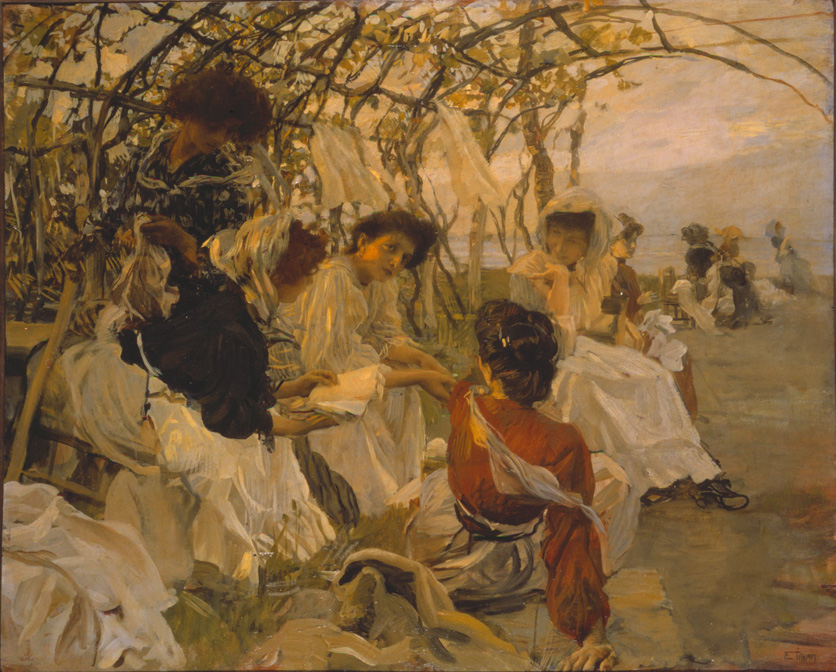
Ettore Tito, Le bagnanti, particolare, 1910, olio su tela, Musei di Nervi - Raccolte Frugone

Raccolte Frugone, salone della Belle Epoque

Click here to view image

Author/ School/ Dating:

Frugone Collections - Belle Epoque Salon

Back to Focus:

Villa Grimaldi Fassio, Raccolte Frugone, salone della Belle Epoque 4

Raccolte Frugone, sala del Simbolismo

Click here to view image

Author/ School/ Dating:

Frugone Collections - Symbolism Room

Back to Focus:

Villa Grimaldi Fassio, Raccolte Frugone, sala del Simbolismo

Holy water cup

Click here to view image

Author/ School/ Dating:

Holy water cup

Technique and Dimensions:

lastra d'argento sbalzato e cesellato - cm 24X16,5

Back to Focus:

La targa centrale a giorno delimitata da un profilo curvilineo a ritmi spezzati, rappresenta l'immagine a tre quarti della Madonna con bambino, secondo l'iconografia assai diffusa nella pittura barocca genovese, specie nella scuola piolesca, ma assai raramente nelle acquasantiere.
I nimbi a raggera, le nuvole a vortice e a spirale che circondano le due figure, i panneggi a pieghe flesse che avvolgono il Bambino, contribuiscono ad accentuare l'effetto plastico dell'immagine e il suo inserimento nello spazio, in una felice realizzazione.
La cornice, partendo dl profilo della targa a ritmi curvi e contrapposti, realizza un gioco simmetrico di volute fogliacee ora rese astratte dalla geometrizzazione decorativa, ora abbandonata agli effetti pittorici della resa naturalistica, fino a pervenire, in cimasa, alla morbida foglia a ventaglio frastagliato.  Da questa si staccano, partendo dal bottone di un fiore centrale, due simmetrici festoni, che si vanno ad incontrare con le ruches laterali, ripetute due volte fino all'imbocco della piletta, la quale è trattenuta alla targa mediante una pelaccetta.
La piletta è d'epoca e stilisticamnete adeguata, ma forse manomessa. Restauro inadeguato anche in basso a destra.
Punzone "torretta" senza data.


Giuliana Biavati

Figurine del Presepe /1

Click here to view image

Author/ School/ Dating:

Figurine del Presepe /1

Back to Focus:
Presentazione al Tempio

Click here to view image

Author/ School/ Dating:

Presentazione al Tempio

Back to Focus:
Subscribe to