


Gerardo Dottori "Aerial Portrait of Mario Carli"

Click here to view image

Titolo dell'opera:

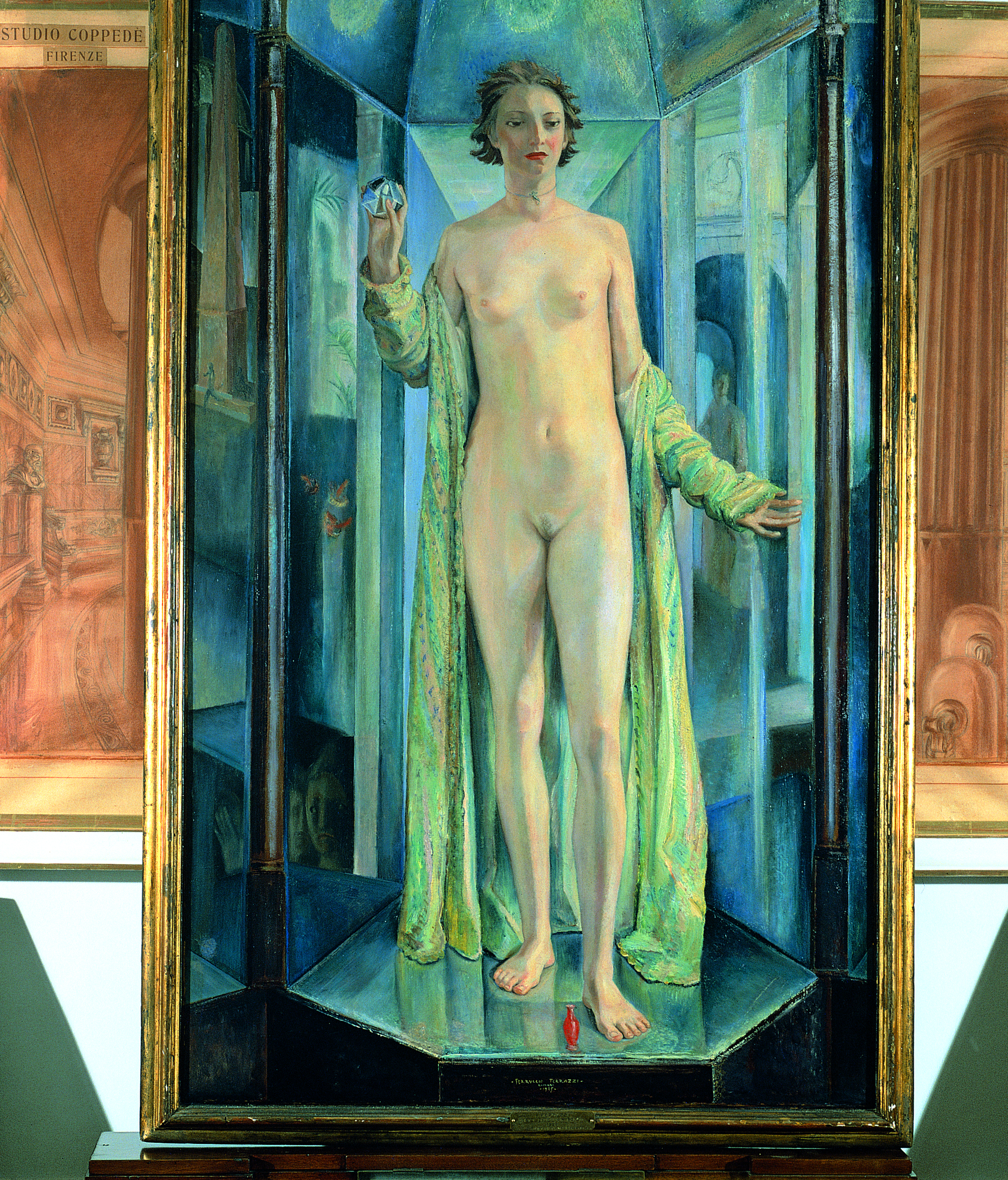
Aerial portrait of Mario Carli

Acquisizione:

Mitchell Wolfson Jr. 2007 Genova - donazione

Author/ School/ Dating:

Gerardo Dottori (Perugia, 1884 circa - 1977)

Object Type:

painting

Epoca:

Inventario:

GX1993.462

Misure:

Unità di misura: cm; Altezza: 159; Larghezza: 129.5

Tecnica:

olio su tela

Descrizione:

When Dottori painted Mario Carli's Air Portrait in 1931, also titled "An Italian of Mussolini", the Futurist writer and activist had by then become an official figure of the regime and was later appointed consul first in Porto Alegre in Brazil and then in Salonika. However, his existential and artistic path had been a bumpy one, revealing the many contradictions inherent in the historical evolution of Fascism. After making his debut in Florence, before the war, as an author of experimental, almost pre-surrealist novels, Carli was one of the leading exponents of Arditism, a phenomenon typical of the original fascist movementism, which proposed the figure of a "new man" intolerant of all rules and conventions, violent and anarchic, radical and provocative, daring and unscrupulous, a man, in short, with ‘the heart of a dynamo, pneumatic lungs, the liver of a leopard’. Animated by these ideals, Carli enlisted as a volunteer in 1917 and was wounded and decorated. He went with D'Annunzio to Fiume and there launched "La Testa di Ferro", the press organ of the Fiuman legionnaires. He was put on trial and arrested several times. To open the way for revolution, he was open to socialist and communist experiences and models, which aroused the suspicions of Marinetti and Mussolini. Following the crisis of Arditism and after the march on Rome, he founded the magazine "L'Impero" with the aim of bringing together the most innovative forces of Futurism and outlining a new culture suited to the prospects of Fascism, until Mussolini, by then consolidated in power and purged the initial subversive spirit of the movement, harnessed it in officialdom to render it inoffensive.

Giovanni Buffa & Guido Zuccaro, Glass round, "Medusa"

Click here to view image

Titolo dell'opera:

Medusa

Acquisizione:

Mitchell Wolfson Jr. 2007 Genova - donazione

Author/ School/ Dating:

Giovanni Buffa (Casale Monferrato, 1871-1956)

Object Type:

tondo

Epoca:

Inventario:

GX1993.396

Misure:

Unità di misura: cm; Diametro: 56

Tecnica:

vetro dipinto e piombato

Ultimi prestiti:

Prima Esposizione Internazionale d’Arte Decorativa Moderna - Torino, Parco del Valentino - 10/05/1902 – 10/11/1902<br>Famiglia Artistica - Milano

Back to Focus:
Descrizione:

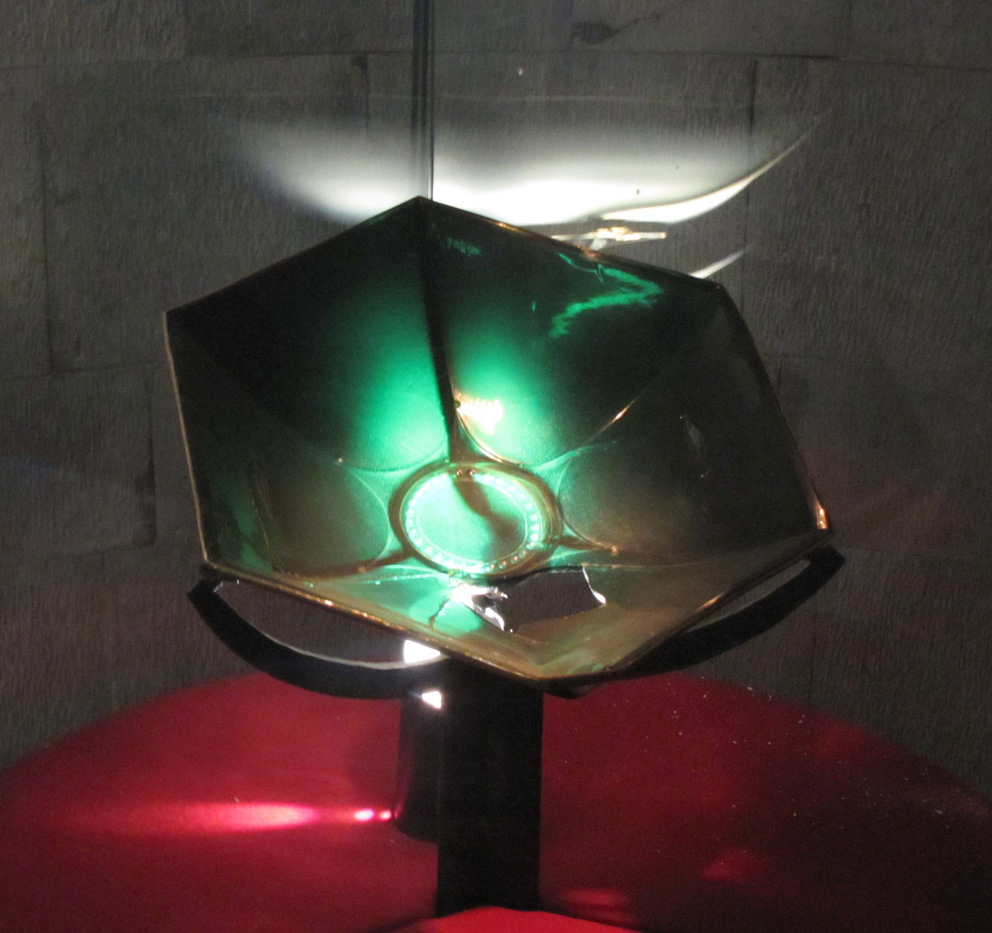
'[...] the hideous image, which the serpents coiled iridescently, is held suspended by the hand of Perseus and stands out red-hot against the sky in all its petrified terror. Already exhibited at the Famiglia Artistica in Milan, it received confirmation of its success in Turin'. With these words, Alfredo Melani commented in September 1902 on the participation of the leaded glass tondo - made by Guido Zuccaro, on a cartoon by Giovanni Buffa, for the G. Beltrami Vetrate Artistiche in Milan - at the First International Exhibition of Modern Decorative Art in Turin.
In discontinuity with the past experiences of historicist matrix, this exhibition, whose official programme foresaw, in the name of a total adhesion to modernity, the strict exclusion of works marked by "simple imitations of styles of the past", represented the first exhibition of international scope organised in Italy after unification.
The leaded glass roundel, made in 1901, is signed with the glassworks' trademark, composed of the initials of the four partners: Beltrami, Buffa, Zuccaro and Innocenzo Cantinotti. The Medusa stained-glass window, however, was executed by Zuccaro alone on a cartoon by Buffa. Adhering to a strand of research that was very much in vogue at the time, in which the model of the demonic and mutant woman - in its disturbing physiognomic correspondence with the animal world - had by then taken over from the traditional angelic and idealised female portrait, this painted and leaded glass tondo presented clear expressive and iconographic analogies with the literary and mythological transpositions of international Symbolist culture, from Franz von Stuck to Gustave Moreau. Glass globe depicting the severed head of Medusa.

Cappuccini Provincial Archive

The historical archive of the Province of Genova of the Friars Minor Cappuccini holds records dating back to 1538, the year when the monks arrived, called by the hospital’s administration to take care of the sick.

Within a century the Province had monasteries spread throughout the Ligurian region, from Sarzana to Mentone, and as far north as Ovada and Voltaggio. The documents testify of the monks’ apostolic activity in the area, the missions in Africa and South America and more generally their relationship with the population and the civil and religious institutions.

The papers reflect the historical events of five centuries, with first-hand reports not only of devotional aspects and charitable practices, but also of works of art, of political and social change and of the recent world wars. The documents are varied in kind and consist of correspondence, notarial deeds, papal seals, decrees, memoirs, monks’ biographies, records of ordinations, paperwork concerning building and restoration work on the church and monasteries, and photographs. The overall quantity comes to around 4000 archival units, all reorganised and inventoried with CEIAr software.

The inventories of the monasteries’ archival assets are published on the Cultural Heritage of the Church website www.beweb.chiesacattolica.it. The Provincial Curia fund, holding the oldest documents relating to the government of the province, the missions and the lives of the monks, has not yet been published but does have a digital inventory.

Top Ten

Musei di Genova Archive Istituto Mazziniano

Archive Istituto Mazziniano

The documentary collections preserved in the Istituto are a fundamental point of reference for historical research.

Created by Arturo Codignola with criteria which no longer meet the dictates of contemporary archival theory (as entire series of documents were then taken from the Historical Archive of the Municipality), it was first catalogued with scientific rigour by Bianca Montale, when she was director of the Istituto Mazzini (1956-1970).

In 2011, on the occasion of the 150th anniversary of the Unification of Italy, the identification and computerised filing of documents was completed, sponsored by the Istituto in collaboration with and under the general supervision of the Archival Superintendency for Liguria, and entirely financed by the Italian Ministry of Cultural Heritage.

Top Ten

Richard Miller "Mulino a Vento"

Click here to view image

Author/ School/ Dating:

Richard E. Miller (St. Louis, 1875 - 1943)

Vecchia olandese

Click here to view image

Titolo dell'opera:

Old Dutch

Acquisizione:

Legato Frugone Genova - legato

Autore:

Miller, Richard Edward

Object Type:

painting

Epoca:

1901 - 1943 - XX

Inventario:

GAM1585

Misure:

Unità di misura: cm; Altezza: 73; Larghezza: 60.5

Tecnica:

olio su tela

Descrizione:

The dramatic melancholy that pervades the work is alleviated by Miller through the use of a vivid orange-red tone for the floral motifs on the blanket, against which the protagonist's sad face is silhouetted. In a humble domestic interior, an elderly woman is seated in front of a fireplace, to the side of the bed-whose backpack can be glimpsed-and the small table, on which a soup tureen and some cups are laid.

Signora con bambina

Click here to view image

Titolo dell'opera:

Mother and daughter. Lady with child

Autore:

Miller, Richard Edward

Object Type:

painting

Epoca:

1906 - 1906 - XX

Inventario:

GPB 809

Misure:

Unità di misura: UNR; Misure mancanti: MNR

Tecnica:

olio su tela

Descrizione:

Typical of Miller's early production is the depiction of bourgeois interiors. The artist takes up the French Impressionist lesson of Renoir in the complexion and hair of the young woman and of the great Manet in the color contrast of the lady's clothes. Happy is the choice to adopt touches of coral red for the accessories of the two protagonists, whose placement on the canvas defines the most interesting portion of the painting. The painting depicts a mother doing needlework flanked by her daughter, who momentarily suspends observing her mother's work to fix her gaze on the painter.

Ritorno dalla pesca

Click here to view image

Titolo dell'opera:

Return from fishing

Acquisizione:

Luigi Frugone 1953 Genova - legato

Autore:

Sorolla y Bastida, Joaquin

Object Type:

painting

Epoca:

1904 - 1904 - XX

Inventario:

GAM 1589

Misure:

Unità di misura: cm; Altezza: 45; Larghezza: 75

Tecnica:

olio su tela

Descrizione:

The painting depicts some fishermen dragging their boat ashore after a long day at sea, with the late evening sun casting long shadows. In the early 20th century, Sorolla's brushstrokes become looser, quicker and more full-bodied, and he builds the image by zones of light and shadow, moved by a thick, serpentine mark, according to a painting style that puts patches of colour before drawing. In ‘Return from Fishing’, signed and dated 1904, the artist achieves vibrant chromatic effects thanks to a palette in which ochre, blue and white colours chase one another in every element of the representation; the chromatic and formal balance of the composition is animated by the vast portion of shadow cast by the figures and the boat on the seashore in contrast to the glare of the light on the water and the other parts of the painting.

Sonnellino in barca (1869)

Click here to view image

Titolo dell'opera:

Naps on the boat

Acquisizione:

Legato Frugone 1953 Genova - legato

Autore:

Sorolla y Bastida, Joaquin

Object Type:

painting

Epoca:

1895 - 1896 - XIX

Inventario:

GAM1590

Misure:

Unità di misura: cm; Altezza: 45; Larghezza: 66

Tecnica:

olio su tela

Descrizione:

The unusual framing, which cuts across the hull horizontally, suggests that it continues beyond the bottom of the canvas and places the painter (and the viewer) inside the boat, allowing him to capture the boy up close: a technique clearly derived from Impressionist painting, which Sorolla became familiar with during his stay in Paris in the second half of the 1880s. The canvas in the Frugone Collections, dated 1895/1896 (perhaps to indicate the start and end dates of the work, or, in the later dating, the time of sale of the painting), is an example of Sorolla's painting linked to costumbrismo (i.e. “folkloric sketches”, a theme widespread in Spain, in painting and literature, throughout the 19th century) that can be defined as maritime, in which a greater detachment from the subject favours the acquisition of that international flavour that would mark the beginning of his success. The study of light becomes a fundamental element here: the shaded area in the foreground makes the brightness beyond the stern even stronger: the glare of the zenithal light is achieved with intense, almost dazzling whites in the rudder, in the slight rippling of the sea waves, and in the boats on the horizon. The sail, barely moved by the wind, closes the painting at the top, allowing the sun's rays to filter through and illuminate small areas of detail in the foreground. ‘Sonnellino in barca’ depicts a child asleep on a boat, in the shade of the sail, on the shore of the sea.

La poupée

Click here to view image

Author/ School/ Dating:

Lucien Simon (Parigi, 1861 - Sainte-Marine, 1945)

Technique and Dimensions:

olio su tela, cm 70x94

Al dipinto, ascrivibile a un periodo anteriore al 1911-12, conosciuto anche come La modellina e il dipinto, sembra in realtà più consono il titolo La poupée: la bambina infatti non appare nel quadro che sta osservando ed è presumibilmente una delle due figlie dell’artista colta nell’atto dì curiosare, con la sua bambola, nello studio del padre. Simon, pur avendo adottato nelle ultime opere una tavolozza molto brillante, mostra in questo dipinto di non aver abbandonato quella prima maniera "oscura", a "solide macchie di colore di tonalità bassa, con qua e là qualche nota vibrante di rosso e di giallo e qualche nota luminosa di bianco...". Questa era la tipicità della sua pittura nell’ambito di quel gruppo di artisti (Cottet, Dauchez, ecc.) che, privilegiando soggetti bretoni, si rifaceva alle tinte sombres di Courbet, in antitesi alla peinture claire impressionista e fu perciò denominato dalla critica, a partire dagli anni Novanta, "la banda nera". Rispetto ad analoghi dipinti dello stesso tema, che ricorre con una certa frequenza nella pittura Belle Epoque, la tela si segnala, soprattutto, per il modo in cui è ritratta la bimba, di spalle, in una posa priva di artificio che riesce a comunicare la sua infantile curiosità per quel luogo misterioso e pieno di fascino, dove non sì è avventurata senza la sua bambola.

Subscribe to