


Click here to view image
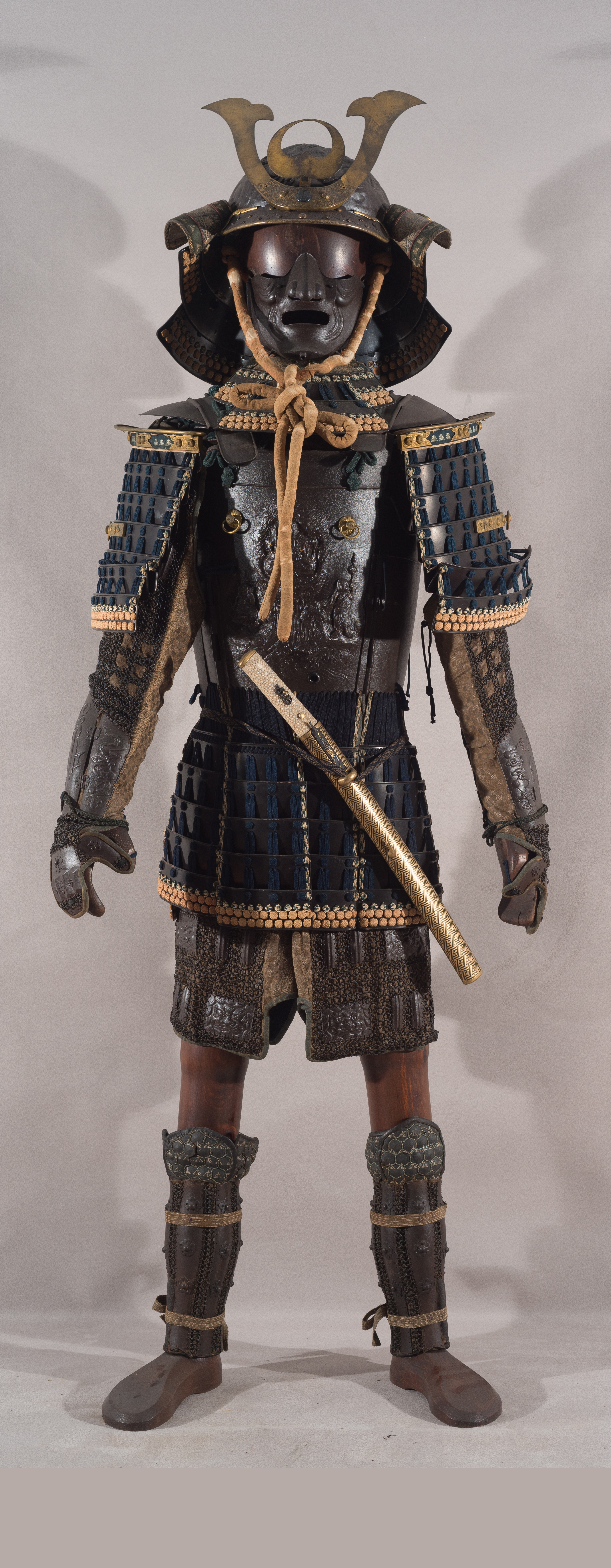
Armor with cuirass decorated with Fudō Myō-ō
Japan, XVII -XIX century
AA7
polymateric
The helmet bowl bears a dragon in relief on the whole surface. The maedate (front decoration) is composed of "u-shaped horns”, decorated in the center with embroidered flowers in relief. The central circular element is a lucky symbol known as “Inome”, corresponding to the "eye of a wild boar." The helmet bears the signature of Myōchin Munetane and can be dated around 1850. The mask is of the me-no-shita-men type with a removable nose.
The shoulder guards have a lacquered iron pseudo-plate construction, held together by interlaced cords. The cuirass ventral plate is decorated with three Buddhist figures in relief: Fudō Myō-ō (snk: Acala), the most important of the Five Kings of Wisdom at the top, Kongara Dōji at the bottom left, and Seitaka Dōji at the bottom right.
This is the Triad of “Fudō Myō-ō” (Fudō Sanzon), a fundamental iconographic representation in Japanese esoteric Mikkyō Buddhism, introduced to Japan from China in the early 9th century, particular for the Shingon school. The tassets of the skirt follow the style of the shoulder guards, with a lacquered iron pseudo-plate construction, connected by interlaced cords. The greaves are composed of hinged metal plates decorated with repoussé floral motifs and interspersed with chainmail.